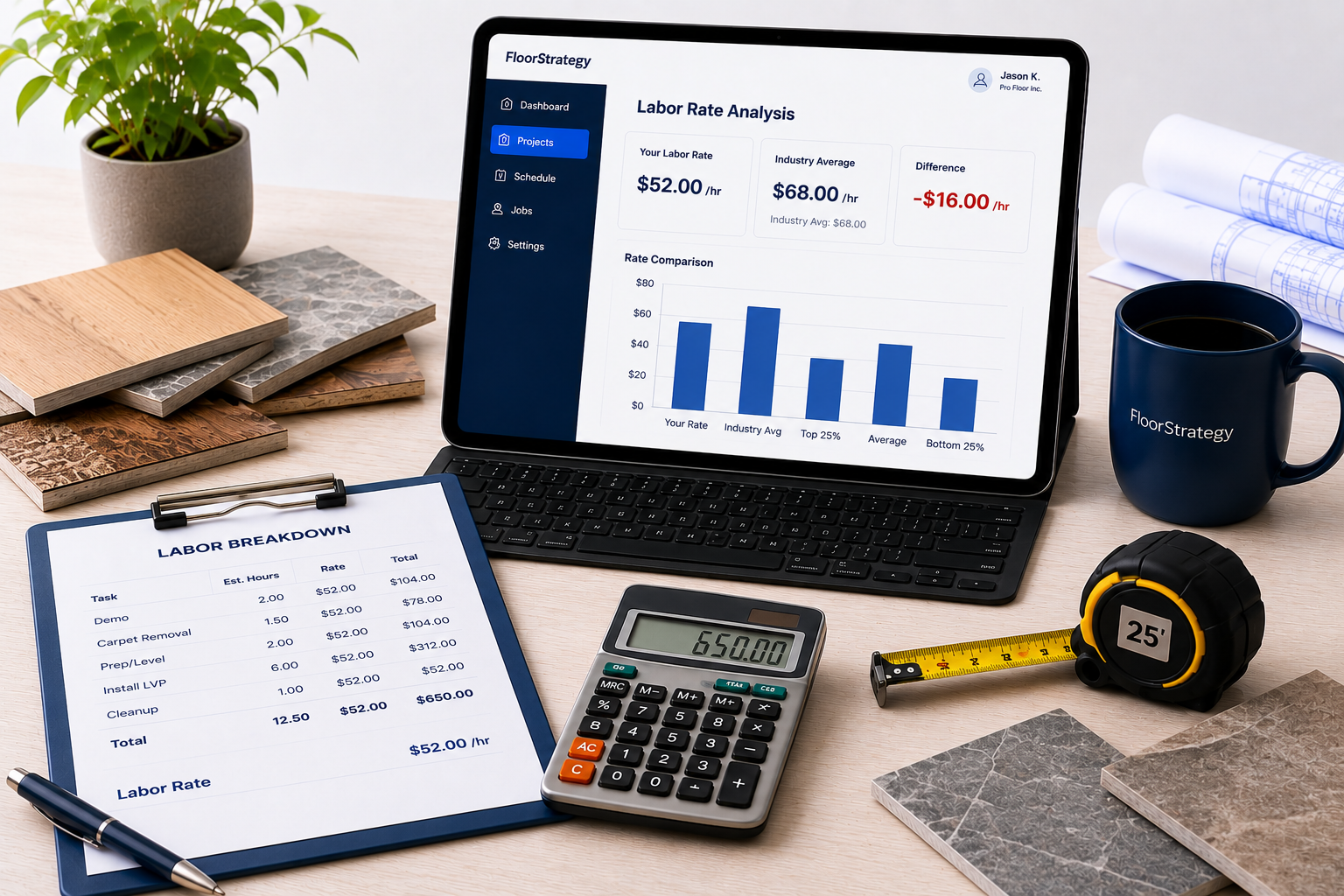
Ask most flooring owners how they came up with their labor rate per square foot and you'll get some version of the same answer. It's what we've always charged, adjusted up a little when materials or gas prices went up. That's not a criticism. It's just how the number usually gets set, and it means most labor rates are more of a tradition than a calculation.
A tradition based number doesn't move with real costs
The problem with a tradition based number is that it doesn't move when the actual cost of labor moves. Installer pay goes up. Jobs get more complicated because customers want more pattern work and tighter tolerances than they used to. Travel time between jobs creeps up as your service area grows. Your labor rate might have been right three years ago. It's probably not right today, and the gap between what it should be and what it actually is comes straight out of your margin on every single job.
A simple way to check your real number
The way to check this isn't complicated, it just takes some honesty. Pick ten recent jobs. For each one, add up the actual hours your installers spent, not the hours you estimated, since comparing sold hours against actual hours is exactly how a drifting rate shows up. Compare that against what you charged for labor on that job. You'll usually find one of two things. Either your rate is close and you can stop worrying about it, or there's a real gap and now you know the size of it instead of just having a feeling that something's off.
Not every job type needs the same rate
Pay attention to which job types are furthest from your rate. A lot of shops find their rate works fine for straightforward installs but badly undercharges on anything with a lot of transitions, stairs, or pattern work. If that's true for you, the fix isn't raising your rate across the board. It's building a couple of different rates for different job complexity, so simple jobs stay competitive and complicated jobs actually cover the real labor going into them, the same outcome focused thinking behind tracking installer performance without micromanaging.
This is also where tracking installer hours by job matters more than most shops realize. If you're not capturing actual hours against the estimate, you're stuck guessing at labor rate accuracy forever instead of just checking it once and knowing.
FloorStrategy tracks actual installer hours against every estimate, so you can check your labor rate once and know instead of guessing forever. Free until July 22.
FAQ
How do I know if my labor rate is too low? Pick ten recent jobs and compare the actual hours your crew spent against what you charged for labor on each one. If the gap is consistent, your rate needs adjusting. If it's close, you're fine.
Should every job type have the same labor rate? Not if you want to stay competitive on simple jobs and profitable on complicated ones. Shops that build separate rates for straightforward installs versus jobs with heavy pattern work or transitions tend to cover their real labor cost more accurately.
Why doesn't a labor rate stay accurate over time? Installer pay goes up, jobs get more complex, and travel time creeps up as a service area grows. A rate that was right a few years ago usually isn't right today unless it's been checked against real hours recently.