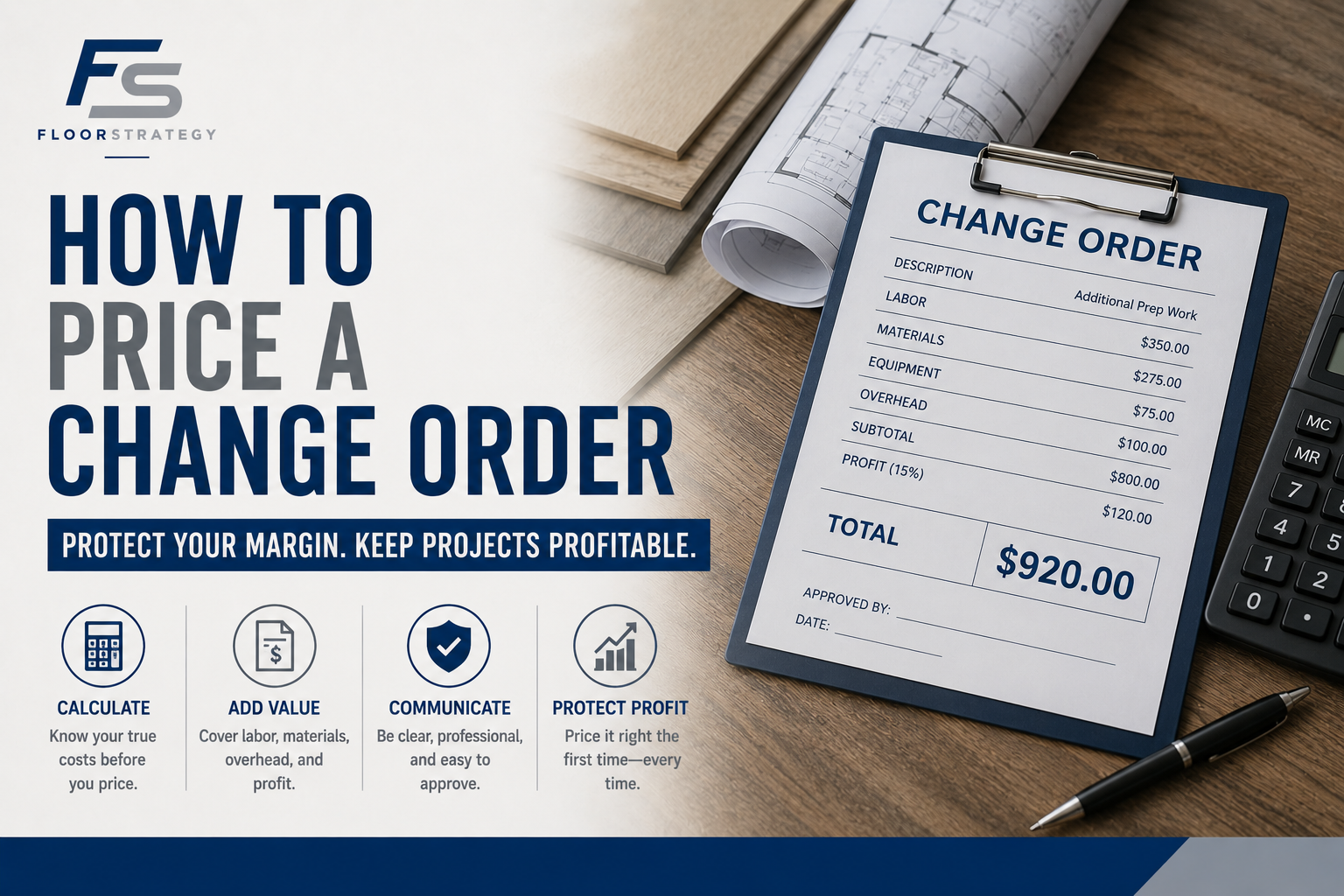
The most expensive two words in flooring might be "no problem."
Customer wants an extra closet floored. Subfloor's worse than expected and needs leveling. The plan changes mid-install. Your installer — who's a good person and wants the customer happy — says "no problem" and just does it. The work gets done. It never gets charged. And another chunk of your margin walks out the door.
Uncharged change orders are one of the biggest silent leaks in this business. Let's fix it.
Why change orders get absorbed
It's almost never laziness. It's friction. Here's how it usually goes:
- The installer's hands are full and doesn't want to stop and call the office over "a little extra."
- Nobody's sure exactly what to charge, so it's easier to just eat it.
- The customer's standing right there and an awkward money conversation feels worse than a few hundred bucks of free labor.
- There's no fast way to document it, so it never gets documented.
Each one feels small in the moment. Stacked up across a month, a shop can absorb thousands without a single person deciding to.
How to price a change order correctly
The good news: change orders should be priced exactly like the original bid. Same formula, no guessing.
If you bid off margin — and you should — the math is:
Price = Cost ÷ (1 − margin %)
So if the extra closet costs you $300 in labor and material and you run a 35% margin:
$300 ÷ (1 − 0.35) = $300 ÷ 0.65 = $461
Not "I'll just add $300." That covers your cost and keeps your business at zero. You're not in business to break even on extra work. Charge the closet at the same margin you charge everything else.
The two mistakes to avoid:
- Marking up instead of margining up. Adding 35% to your cost ($300 × 1.35 = $405) is not a 35% margin — it's a 26% margin. Use the divide-by formula.
- Forgetting the soft costs. Extra trips, restocking, the time to source an odd material — those are real. Build them into the cost before you apply margin.
The real fix is removing the friction
You can know the perfect formula and still absorb change orders if charging one is a pain. The actual solution is making it fast and normal:
-
Make documenting a change a 60-second job, in the field. If your installer can snap a photo and log the extra scope from their phone before they start, it'll actually happen. If it requires a phone call to the office, it won't.
-
Price it on the spot with a known formula. No "let me check with the boss." Cost in, margin applied, number out.
-
Get a quick approval from the customer before the work. A signed or texted yes turns an awkward after-the-fact bill into an expected charge. Customers rarely fight a change they agreed to up front — they fight surprises.
-
Make sure it flows into the job's totals. A change order that gets charged but never makes it into the job's produced margin still distorts your reporting. It should land on the job automatically.
This is exactly why FloorStrategy's change order tool lets the field log extra scope and expenses from a phone, prices it off your real margin, and rolls it straight into the job's totals — so the work that used to get absorbed actually gets billed.
The bottom line
Change orders aren't favors. They're work, and work has a cost and a margin. The shops that bleed money on them don't have a pricing problem — they have a friction problem. Make charging a change as easy as doing one, price it off your real margin, and get a yes before the work starts. Do that and one of your biggest silent leaks turns into billed revenue.
Stop doing free field work. FloorStrategy makes change orders a 60-second job — free until July 22.
FAQ
How do I price a flooring change order? Price it off margin, same as your original bid: Price = Cost ÷ (1 − margin %). Don't just mark the cost up by your margin percentage — that gives you a smaller margin than you think.
Why do my installers keep doing free work? Usually friction, not carelessness. If logging and charging a change is slow or awkward, it won't happen. Make it a fast, normal, in-the-field step and absorbed work turns into billed work.
Should I get customer approval before doing change order work? Yes, every time you can. A quick approval up front turns a surprise bill into an expected charge, and customers almost never push back on changes they agreed to before the work started.