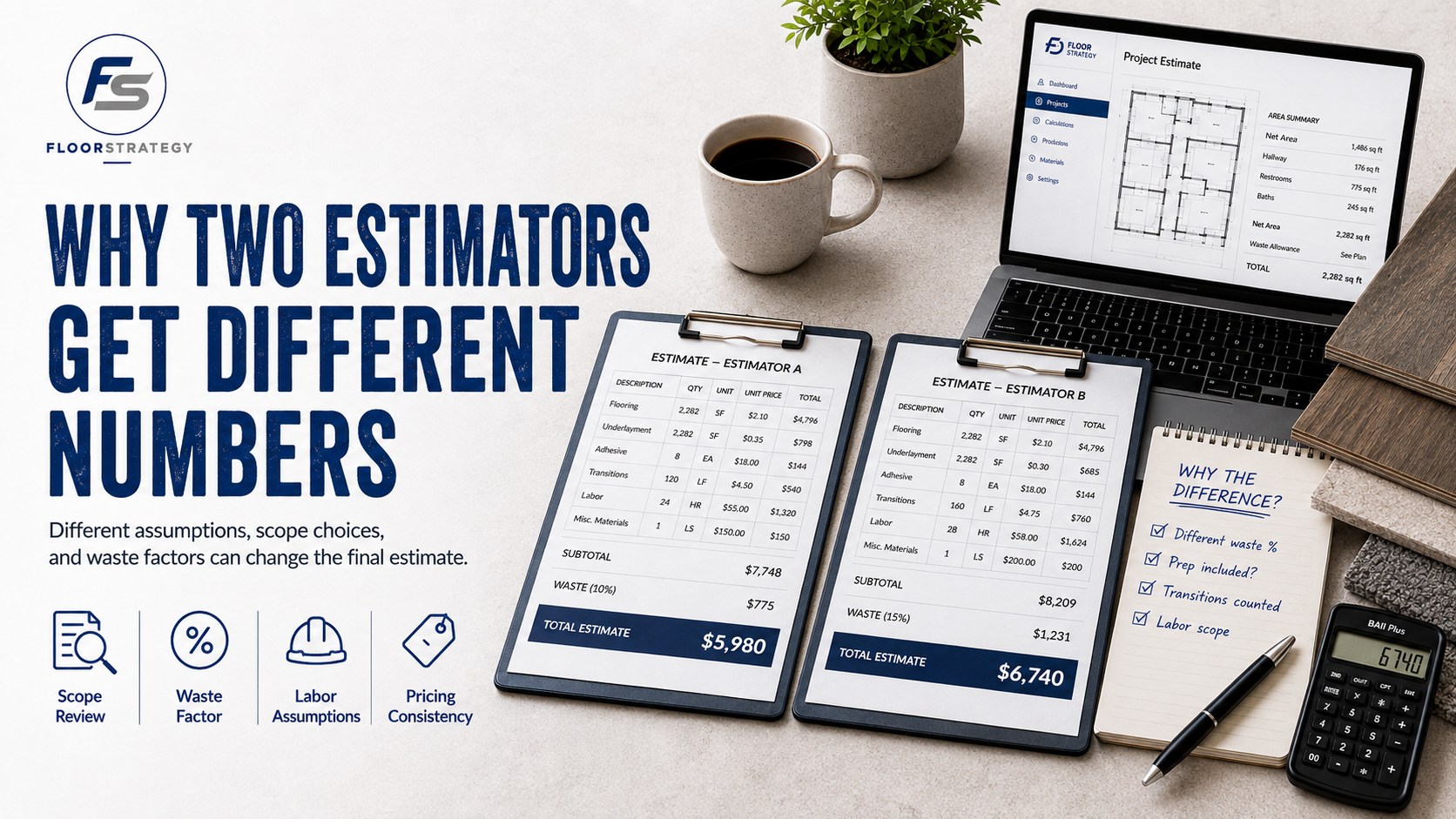
Send two experienced estimators to measure the exact same room, and it's not unusual for them to come back with two different numbers — sometimes close, sometimes not close at all. If that's ever happened at your shop, it's not because one of them is bad at the job. It's because "estimating" is actually a bundle of smaller judgment calls, and different people make those calls differently by default.
Where the divergence actually happens
- Waste factor. One estimator's gut-feel "about 10%" is another's gut-feel "about 15%" for the exact same layout, because neither of them is working from a documented standard — they're working from memory and instinct.
- What counts as part of the room. Does a closet get its own line item or get folded into "the bedroom"? Does a hallway transition get measured separately? Different habits, different totals.
- Labor time assumptions. One estimator assumes a standard crew pace. Another mentally adjusts for "this house has narrow doorways, that'll slow things down" — a real consideration, but one that isn't applied consistently unless it's written down somewhere as a standard.
- How site conditions get weighted. Existing flooring removal, subfloor prep, furniture moving — these get eyeballed differently depending on who's doing the walkthrough and how thorough they're feeling that day.
Why this matters more than it seems like it should
If your shop has more than one person estimating jobs, inconsistent numbers aren't just an internal curiosity — they show up as unpredictable margins. A job that should perform the same as a similar job last month performs differently because it was priced by someone with a different set of default assumptions. Multiply that across a year of jobs and you've got margin variance that has nothing to do with the market and everything to do with who happened to measure which house.
The fix isn't hiring more consistent people — it's writing the standards down
Nobody's default assumptions are wrong, exactly. They're just personal. The fix is turning the personal defaults into shared ones: a documented waste factor by layout type, a standard for what counts as its own line item versus what folds into a room, a labor-time adjustment guide for common complicating factors. Once those exist on paper (or in whatever system your estimators are actually using day to day), two different people measuring the same room should land within a few percent of each other — not because they've become the same person, but because they're working from the same starting assumptions instead of two different sets of gut instinct.
That consistency is worth more than any individual estimator's particular skill, because it's the difference between "we got lucky with who measured this one" and "we can actually predict our margin before the job starts."