By Garrett Green, flooring production manager and founder of FloorStrategy
A client asks for one small thing on-site. The installer says sure, no problem, and does it. Nobody writes it down. Three weeks later, that "no problem" is either eating into the job's margin or it's an awkward line item on the invoice that the client doesn't remember agreeing to.
Multiply that across every job where something small gets added on the fly, and you've got a pattern — not a one-time thing, a pattern — of work that's happening but never quite making it onto paper, and never quite making it onto the invoice either.
The Verbal Approval Problem
Almost every change order starts the same way: someone asks for something, someone else says yes, and the conversation moves on. On a job site, this makes sense — stopping to fill out paperwork for every small adjustment would be its own kind of chaos.
But "someone said yes" and "this is documented, priced, and the client knows it'll be on the invoice" are very different things. The gap between those two is where margin disappears. Not because anyone's being dishonest about it — usually everyone genuinely intends to handle it later. It's that "later" competes with everything else going on, and small verbal agreements are exactly the kind of thing that gets lost in the noise of running multiple jobs.
Where the Cost Actually Lands
When a change order isn't documented, one of two things tends to happen. Either the cost gets absorbed — extra material, extra labor, and nobody bills for it, because by the time anyone's putting together the final invoice, the verbal agreement from three weeks ago is foggy at best. Or it does make it onto the invoice, but as a surprise to the client, who remembers a casual conversation on-site very differently than a line item with a dollar amount attached to it.
Neither outcome is good. The first one is a direct hit to margin — small on any individual job, but it adds up. The second one is a relationship problem. A client who feels blindsided by a charge they don't remember agreeing to is a client who's going to scrutinize every future invoice more carefully, and who's a lot less likely to refer your business to someone else.
It's Not Really About the Money — It's About the Record
Here's what's easy to miss: most clients aren't trying to get something for free. If you asked them directly — "hey, we did this extra work, here's what it costs" — most would say that's fair. The problem isn't that clients are unreasonable about paying for legitimate extra work. It's that by the time the conversation happens, if it happens at all, there's no record of what was actually agreed to, so it feels like a negotiation instead of a confirmation.
A documented change order — even something simple, a short description and a price, captured at the time the work is requested — changes that conversation entirely. It's not "do you remember agreeing to this?" It's "here's what we discussed, here's the cost, does this look right?" Same work, same cost, completely different conversation.
Why "We'll Write It Up Later" Doesn't Work
The instinct to handle paperwork later — after the job, when there's time to sit down and document everything properly — is understandable. But it doesn't really work for change orders, for a simple reason: change orders happen in the moment, on-site, often when nobody has easy access to a way to formally capture them.
By the time "later" arrives, a few things have usually happened. The specifics are fuzzier than they were in the moment. There are other jobs competing for attention. And the client conversation that should happen close to when the work was done — while it's fresh, while it feels like a confirmation rather than a surprise — has been delayed long enough that it now feels like one.
The fix isn't "be better about writing things up later." It's making the in-the-moment capture itself fast enough that it actually happens in the moment — a quick note with a description and a cost, right when the change comes up, rather than a mental note to deal with it eventually.
What This Looks Like When It's Working
When change order capture is working well, a few things are true. The change gets documented close to when it's requested — not necessarily instantly, but close enough that the details are still accurate. The client sees it close to when it happens, so it reads as a confirmation of something recent rather than a surprise about something from weeks ago. And it flows into the final invoice automatically, so there's no separate step where someone has to remember to go back and add it.
None of this requires a complicated process. It requires the capture step to be fast and to happen close to the moment — which is really the whole difference between a change order that protects your margin and one that quietly doesn't.
The Bigger Pattern
Change orders aren't really a "sometimes" problem — on any job with enough complexity, something usually comes up. The question isn't whether change orders happen. It's whether your business has a way of capturing them that's fast enough to actually get used, every time, even on a busy day.
The flooring businesses that don't lose margin to this aren't the ones where nothing ever changes mid-job. They're the ones where, when something does change, there's a record of it before anyone has time to forget the details — or the conversation.
Want estimates, scheduling, and client communication in one place? Start your free 14-day trial. No credit card required.
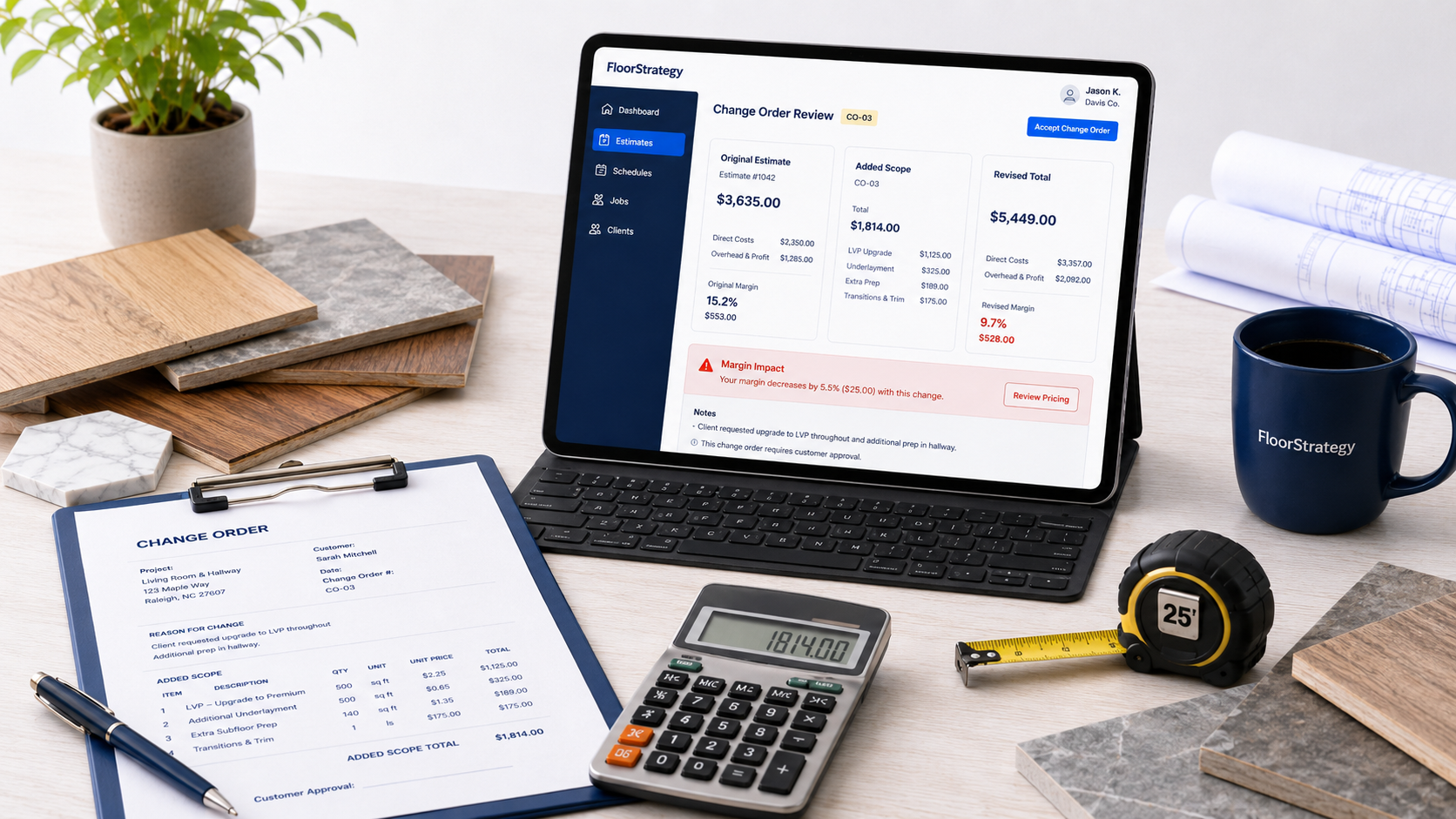
FloorStrategy's change order tracking lets you capture scope changes on the spot — documented, priced, and ready for client approval before the details get fuzzy.