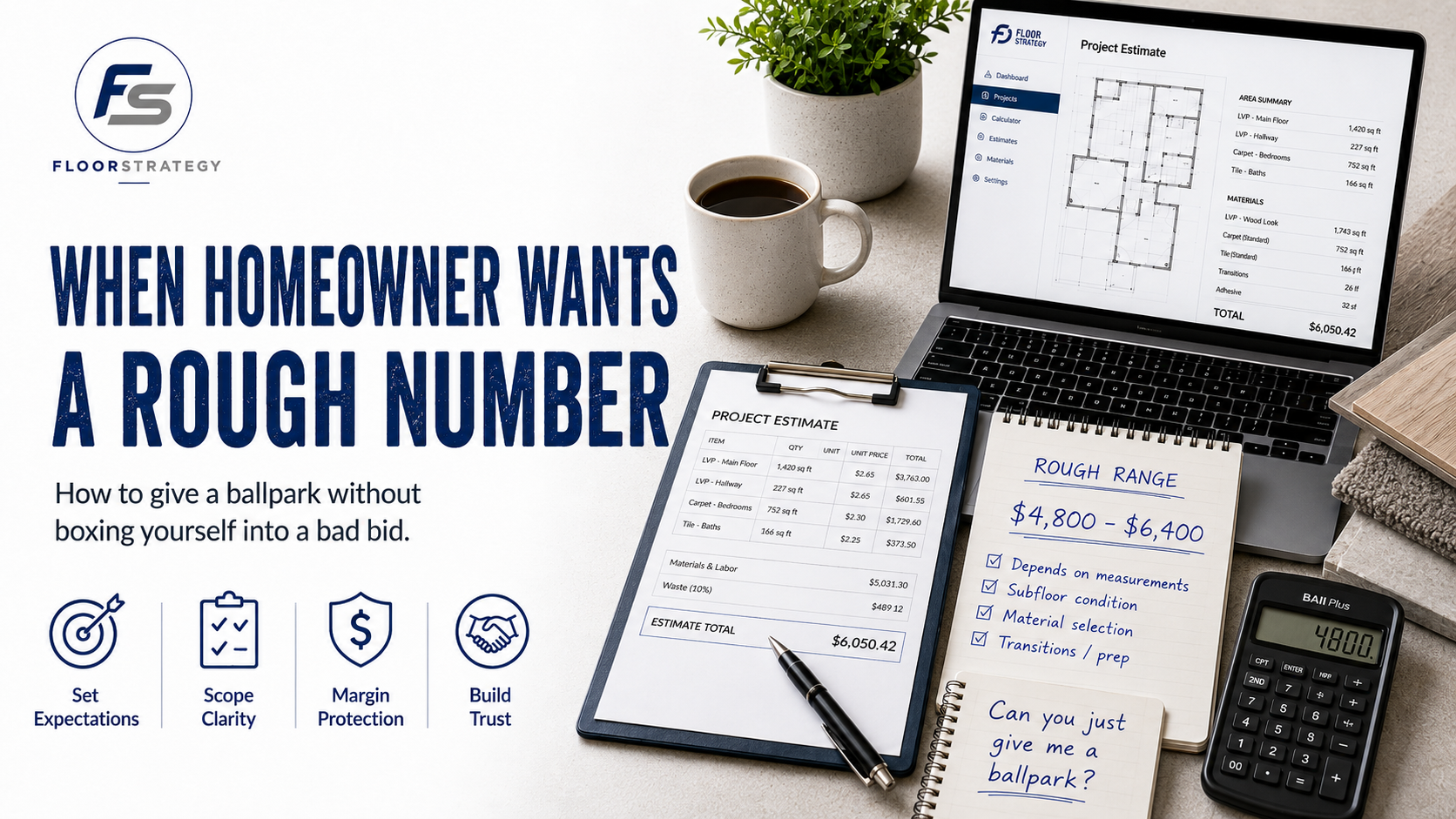
"I don't need anything official, just give me a rough idea." It sounds like a low-stakes request. It's actually one of the most dangerous questions in flooring sales, because whatever number you say out loud in that moment becomes the number the customer remembers — official or not.
Why "rough" numbers don't stay rough
Once a homeowner hears a figure, that figure becomes their anchor. If your real bid comes in higher than the "rough" number you tossed out during a driveway conversation, you're not presenting a bid anymore — you're defending a price increase, even though nothing actually increased. The rough number was just wrong, but it doesn't feel that way to the customer.
The temptation, and why it backfires
Salespeople give rough numbers because they don't want to seem evasive, and because a fast answer feels like good customer service in the moment. But a rough number that turns out low doesn't build trust — it spends trust you haven't earned yet, and you pay it back later at the worst possible moment, mid-negotiation on the real bid.
A better way to handle the question
You don't have to refuse to answer. You have to answer with a range wide enough to actually be true, and framed so the customer understands why it's a range and not a number.
Something like: "For a room this size with this kind of material, jobs like this typically land somewhere between [X] and [Y] — the exact number depends on things like subfloor condition and how much prep the space needs, which I'll know once I've measured everything properly." That's not evasive. It's accurate, and it sets up the real number as a refinement of what you already said, instead of a surprise.
The range only works if it's a real range
This only holds up if the low end and high end are both numbers you'd actually be comfortable delivering on. If your "rough range" is secretly just padding around a number you're hoping to hit, you're doing the same damage as a single rough number — just with worse math.
What this actually protects
It's not really about protecting the sale. It's about protecting the relationship between what you say and what you deliver. A customer who hears an honest range and later gets a bid inside that range trusts every number you give them after that. A customer who hears a "rough" figure that turns out to be fiction stops trusting any number you say out loud — including the real bid, even if it's completely fair.