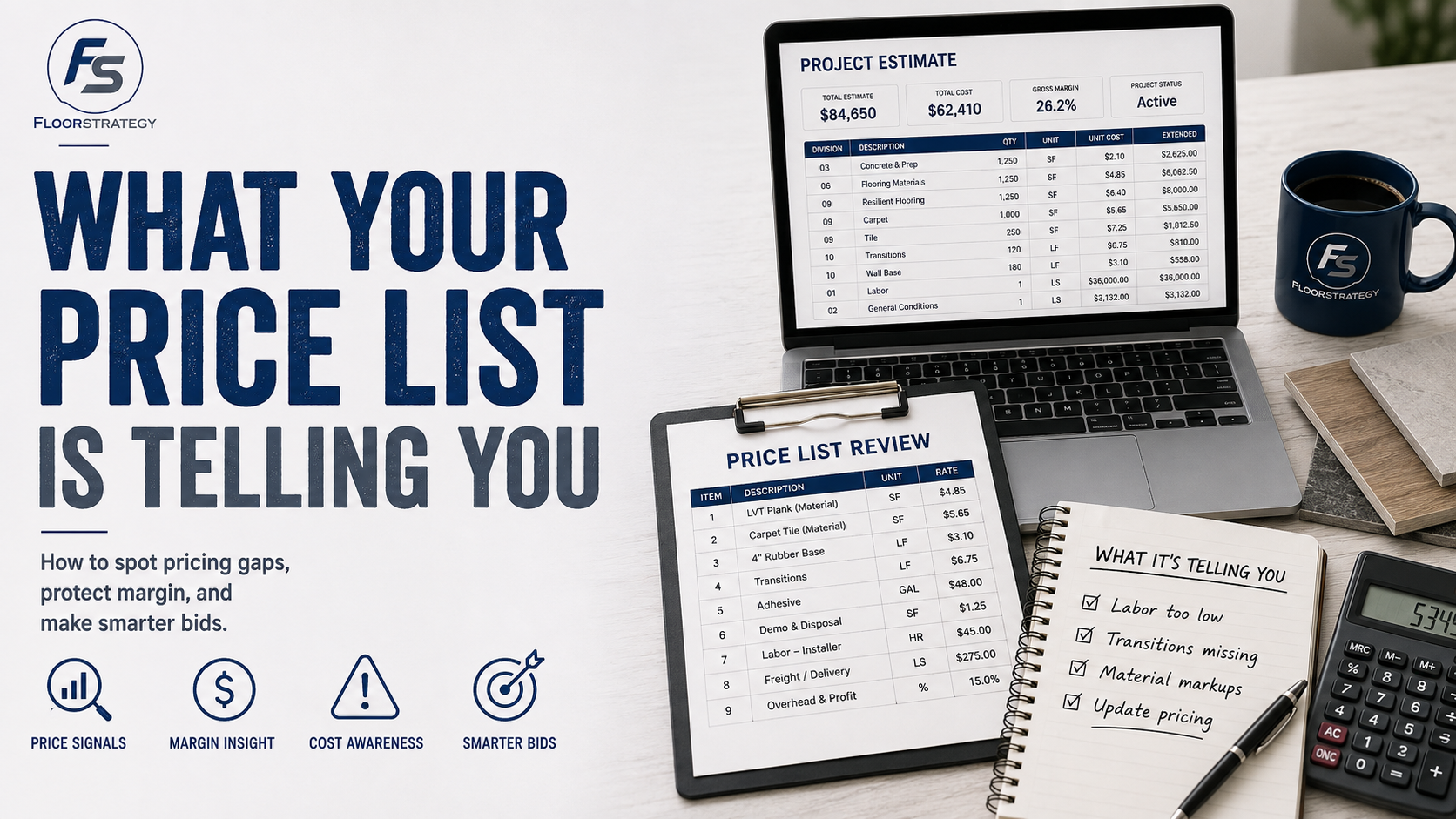
Most shops treat their price list as a utility — something you update when a supplier changes cost, and otherwise don't think about much. That's a missed opportunity, because a price list that's been in use for a while is actually a pretty honest record of the decisions your business has made, whether anyone meant it to be or not.
What a stale price list reveals
If certain materials or labor rates haven't been touched in a long time, that's not neutral — it means every job using those numbers has been priced against outdated costs. Sometimes that's fine, because the underlying cost genuinely hasn't moved. More often, it means margin is quietly eroding on exactly the jobs that use those line items most, because supplier costs crept up in small increments that nobody went back and matched in the price list.
What an inconsistent price list reveals
If similar materials have wildly different markup percentages from each other, with no clear reason why, that usually means the price list grew job by job rather than by design — someone priced a material for a specific job once, using whatever felt right at the time, and that number just stuck as the standing rate. Nothing wrong with that as a starting point, but it's worth periodically checking whether those original one-off decisions still make sense as permanent policy.
What a price list with too many "custom quote" entries reveals
Every line item that says "quote as needed" instead of a real number is a place where estimating speed and consistency both take a hit — because it means every job with that material is being priced from scratch, by whoever happens to be estimating it that day, using whatever assumptions they personally default to (see: the estimator-variance problem happening at line-item scale). A price list with a lot of these isn't wrong, but it's a signal that some materials have outgrown "custom" status and are common enough now to deserve a real standard rate.
The bigger point: your price list is a decision log, whether you treat it like one or not
Every number in it reflects a choice somebody made — sometimes deliberately, sometimes just because it was easier than figuring out the right number in the moment. Reviewing it periodically isn't just pricing maintenance. It's a chance to ask whether those old choices still reflect how you actually want to run jobs today, or whether they're just inertia wearing the shape of a policy.
A price list nobody's looked at in a year isn't dangerous because the numbers are wrong, necessarily. It's dangerous because nobody's checked whether they're still right — and the only way to find out is to actually look.