By Garrett Green, flooring production manager and founder of FloorStrategy
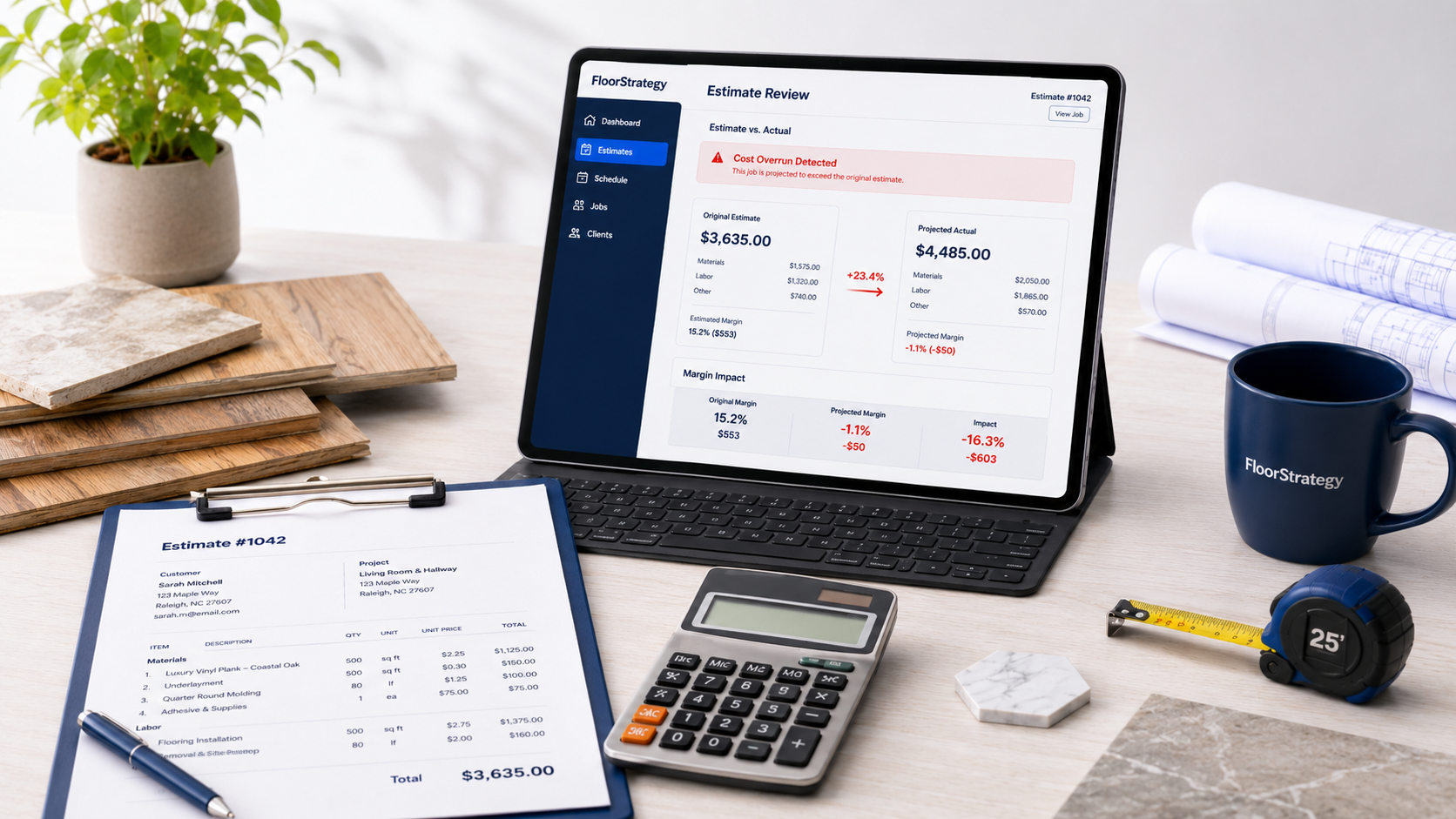
Why does a job that looked fine on paper end up costing more than the estimate said it would?
Sometimes it's the subfloor — more prep than expected. Sometimes it's labor, taking longer because of how the rooms are laid out. Sometimes a material order comes up short and a second delivery has to be expedited at a worse price. The specific reason changes job to job. The result doesn't: the job costs more than quoted, and that gap comes out of margin.
One job like that isn't a crisis. A pattern of jobs like that, month after month, is a business working hard without actually making what it should.
Key takeaways: Underestimating shows up in three places — materials, labor, and unplanned scope. Each one quietly erodes margin in a different way. The fix isn't padding every estimate defensively; it's understanding exactly where your estimates tend to be optimistic, and correcting for it specifically.
The Material Gap
The most direct cost of underestimating: ordering less material than the job needs. Maybe the square footage was measured a little light. Maybe the waste factor didn't match the material. Maybe a space — a closet, a hallway — got missed entirely.
When this happens, you're not just paying for more material — you're paying for an expedited second order, possibly at a worse price than your original bulk order, and you're paying for the schedule disruption while everyone waits for it to arrive. An installer who shows up to finish a job and can't because materials ran short isn't just unproductive that day — they may need to be rescheduled to a different job, which has its own ripple effects on your calendar.
The material gap is usually a measurement problem, which is why getting square footage right — measuring every space individually, applying the correct waste factor per material — matters so much. It's the first line of defense against this specific cost.
The Labor Gap
Labor underestimating is sneakier. It doesn't show up as a number on an invoice. It shows up as an installer on a job longer than planned — which means either they're getting paid for more hours than the job was priced for, or they're rushing to hit the original timeline and the finish suffers for it.
Labor underestimating usually happens because the estimate treated a complex job like a simple one. Five small rooms with multiple transitions take meaningfully longer per square foot than one large open room — even at the same total square footage. Old flooring that needs removal, subfloor issues that need addressing, furniture that needs moving — all of these add time that a square-footage-only labor calculation misses.
The cost here is twofold. If you're paying installers hourly or by crew day, the extra time comes straight out of the job's margin. And if your installers are paid by the job rather than by the hour, the cost shows up differently — as installer frustration, lower quality on a rushed finish, or installers who start avoiding your jobs because they know the time estimates don't match reality.
The Scope Gap
The third place underestimating costs you: work that happens on the job but was never priced into the estimate at all.
Sometimes this is unavoidable — you don't know what's under the existing flooring until it comes up, and subfloor damage is a real possibility on any job. But sometimes it's scope that could have been anticipated and discussed at the estimate stage, and wasn't, because the estimate was focused on getting a number out the door quickly.
The real cost here isn't just the extra labor and materials for the additional work — it's the conversation that has to happen with the client about it. If the original estimate didn't set expectations about what happens when something unexpected is found, that conversation becomes a negotiation, sometimes a tense one. Either you absorb the cost to avoid the conflict, or you have an uncomfortable conversation about additional charges for something the client didn't budget for.
This is exactly why setting expectations inside the estimate itself — what's included, what happens if something unexpected comes up — matters so much. It doesn't prevent the unexpected issue, but it prevents the issue from becoming a margin-eating, relationship-damaging dispute.
Padding Isn't the Fix
The natural reaction to all of this is to pad every estimate. Add a buffer to materials, a buffer to labor, some cushion so that even when things go sideways, the job stays profitable.
The problem with blanket padding is that it makes you less competitive on the jobs that genuinely don't need it, while still not necessarily covering you on the jobs that do. A simple, straightforward job with a flat, open layout doesn't need the same buffer as a complex multi-room job with old flooring removal — but a flat percentage padding treats them the same.
The better fix is specificity: know where your estimates tend to run optimistic, and correct for those specific things. If labor estimates consistently run light on multi-room jobs with lots of transitions, build that into how you estimate labor for that type of job — not into every job equally.
The Compounding Part
Here's what's easy to miss: underestimating doesn't just cost on the individual job where it happens. It compounds, because the same patterns tend to repeat across similar jobs. If labor estimates consistently run light on multi-room jobs, that's not a one-time hit — it's a recurring discount being given on every job of that type, month after month, often without anyone noticing.
This is also why it's worth occasionally looking back at completed jobs and comparing the original estimate to what actually happened — not to assign blame, but to spot the patterns. Was the gap in materials, labor, or unplanned scope? Was it specific to a certain type of job, or a certain type of material? Those patterns are the most valuable information you have for tightening up future estimates.
The Bottom Line
Underestimating isn't usually one big dramatic mistake — it's small gaps in materials, labor, and scope that individually seem minor but add up across every job you do. The businesses that protect their margin best aren't the ones who never have surprises. They're the ones whose estimates are specific enough that the surprises are rare, and small enough not to matter when they do happen.
Getting there starts with the same things we've talked about in this cluster — accurate, room-by-room measurements, labor estimates that account for job complexity rather than treating everything as square-footage-times-a-rate, and estimates that set expectations clearly enough that unexpected scope doesn't become an unexpected conflict.
Want estimates, scheduling, and client communication in one place? Start your free 14-day trial. No credit card required.
Want estimates that account for job complexity automatically? FloorStrategy's estimating tools help you build accurate, room-by-room estimates — so the gaps that quietly eat your margin get caught before the job starts, not after.