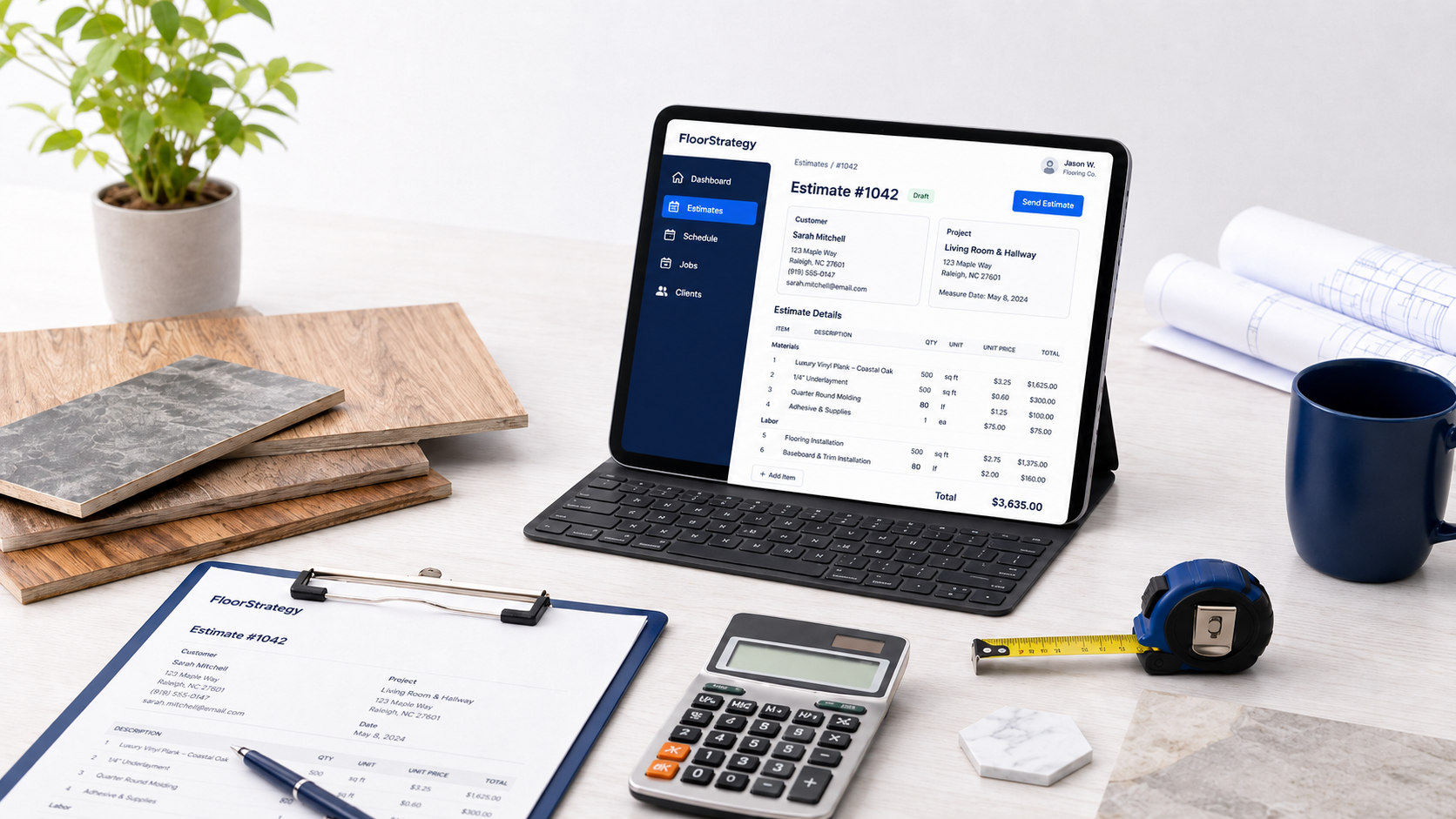
If you've been in flooring for any length of time, you already know this truth: the estimate is often the first real impression a client has of your business. Before they see your installers, before they see your work, before they know anything about how reliable you are — they see your estimate. And in a lot of cases, they're comparing it side by side with one or two others.
That means the estimate isn't just a price. It's a sales document, a trust signal, and a preview of what it's like to work with you. Get it right, and you win the job before the conversation even gets to negotiation. Get it wrong — vague, slow, hard to read — and you lose jobs you were actually qualified to win.
Here's how to write flooring estimates that close more business, protect your margins, and make your company look like the professional option.
Key takeaways: Accurate measurements protect your margin. Clear, itemized line items build client trust. Speed often determines who wins the job. And expectations — what's included and what's not — should be written into the estimate itself, not discussed verbally.
Want estimates, scheduling, and client communication in one place? Start your free 30-day trial — no credit card required.
Start With an Accurate Measurement, Not a Guess
Every estimate problem traces back to one thing: bad measurements. If your square footage is off, everything downstream — material costs, labor hours, the final price — is off too. And clients notice when a "final" number changes significantly once work starts. It erodes trust fast, even if the change was justified.
The old-school approach is a tape measure and a notepad, and for small, simple rooms that still works fine. But for anything with multiple rooms, odd angles, or a blueprint involved, manual measurement is where most estimating time gets lost — and where most errors creep in.
If you're working from a floor plan, take the time to read it carefully. Note every room, every transition, and anything unusual — bump-outs, closets, stairs. These are the details that get missed when someone is estimating quickly, and they're exactly the details that turn into change orders later.
Build Your Estimate Around Real Material Costs — Not Last Quarter's Prices
Flooring material costs move. Sometimes a lot, sometimes overnight. If your price list is even a few months old, you could be quoting numbers that don't reflect what you'll actually pay when you order.
This is one of the most common ways flooring businesses lose margin without realizing it. The estimate gets approved at one number, materials get ordered three weeks later at a higher price, and that gap comes straight out of your profit. Multiply that across a dozen jobs a month and it adds up to real money.
The fix is simple in concept, harder in practice: keep your price lists current. Whether that means checking supplier pricing before sending out estimates, or maintaining a running price list that gets updated regularly, the goal is the same — your estimate should reflect what materials will actually cost when you order them, not what they cost when you last checked.
Don't Forget Labor — And Don't Underestimate It
Material costs are usually the easier half of an estimate. Labor is where things get tricky, because labor isn't just "square footage times a rate." It depends on the type of flooring, the condition of the subfloor, how many rooms and transitions are involved, whether furniture needs to be moved, and how experienced your crew is.
A simple, open room with LVP going down on a clean subfloor is a very different job than the same square footage spread across five small rooms with multiple transitions and old tile that needs to come up first. If your estimating process treats both of those the same way, you're either overcharging on the easy jobs or — more dangerously — underestimating the complex ones.
Take the time to actually think through the labor for each space, not just the total square footage. It takes a few extra minutes per estimate, but it's the difference between a number that holds up and a number that quietly erodes your margin over the life of the job.
Make the Estimate Easy to Read — Clients Decide Fast
Here's something that's easy to overlook: clients often don't read estimates carefully. They scan them. They're looking for the bottom line, what's included, and whether it feels organized and professional.
If your estimate is a wall of numbers with no structure, or if it's handwritten and hard to follow, you're making the client work harder to understand what they're getting — and that friction works against you, even if your price is fair.
A well-organized estimate breaks the job down by room or area, clearly shows materials and labor, and presents a final number that's easy to find. It should look like it came from a business that has its act together. Because for a lot of clients, that's exactly what they're evaluating — not just the price, but whether this is a company they can trust to show up and do what they say.
| Bad Estimate | Winning Estimate | |---|---| | One lump sum with no breakdown | Itemized by room, material, and labor | | Handwritten or inconsistent formatting | Clean, consistent layout every time | | No mention of what's included | Clearly states what's included and excluded | | Sent days after the walkthrough | Delivered within 24-48 hours | | Vague on materials ("LVP flooring") | Specific ("Luxury Vinyl Plank – Coastal Oak, 7mm") |
Speed Matters More Than You Think
There's a reason "the first estimate often wins" is a common saying in this industry. Clients calling multiple flooring companies are often working on a timeline — they want to make a decision and move forward. If your estimate takes a week to put together while a competitor gets theirs out in two days, you may be out of the running before your number even gets seen.
This is especially true for straightforward residential jobs where the client isn't doing extensive due diligence — they're getting two or three quotes and going with whoever feels easiest and most responsive. Estimating speed isn't about cutting corners. It's about removing the bottlenecks in your process so that "accurate" and "fast" aren't in conflict.
For a lot of flooring businesses, the biggest bottleneck is exactly what we talked about above — reading a blueprint and pulling out room dimensions. That single step can take hours for a commercial job. Tools that speed up blueprint reading and square footage extraction don't just save you time — they directly affect how many jobs you're able to bid on and how fast you can respond when a hot lead comes in.
Set Expectations Inside the Estimate Itself
A lot of disputes that happen mid-job — about scope, about what's included, about pricing — trace back to things that were never clearly stated in the estimate. If "removal of existing flooring" wasn't explicitly listed, and the client assumed it was included, you've got a conversation ahead that nobody wants to have.
The estimate is your chance to set those expectations up front, in writing, before anyone has agreed to anything. What's included. What's not included. What happens if something is discovered once work starts — like subfloor damage that wasn't visible during the walkthrough. None of this needs to be complicated or legalistic. It just needs to be clear.
This isn't about covering yourself defensively — though it does that too. It's about making sure the client genuinely understands what they're buying, so there are no surprises for either side later.
The Bigger Picture: Your Estimate Is Your First Job
Every estimate you send is doing double duty. It's quoting a price, and it's also showing the client what kind of company they'd be working with. Accurate, professional, fast, and clear — those four things tell a client a lot about what to expect if they hire you.
The flooring businesses that consistently win jobs aren't always the cheapest. They're the ones whose estimates feel trustworthy — organized, accurate, and delivered quickly enough that the client doesn't feel like they're waiting in the dark.
If your estimating process currently relies on manual measurements, outdated price lists, and a format that's more "notepad" than "proposal," there's room to tighten things up — and the payoff isn't just winning more jobs. It's winning the right jobs, at prices that actually hold up once the work begins.
Want to see how FloorStrategy speeds up estimating? Our AI-assisted blueprint reader pulls room dimensions directly from floor plans, so you can build accurate estimates in a fraction of the time — without sacrificing the details that protect your margin.