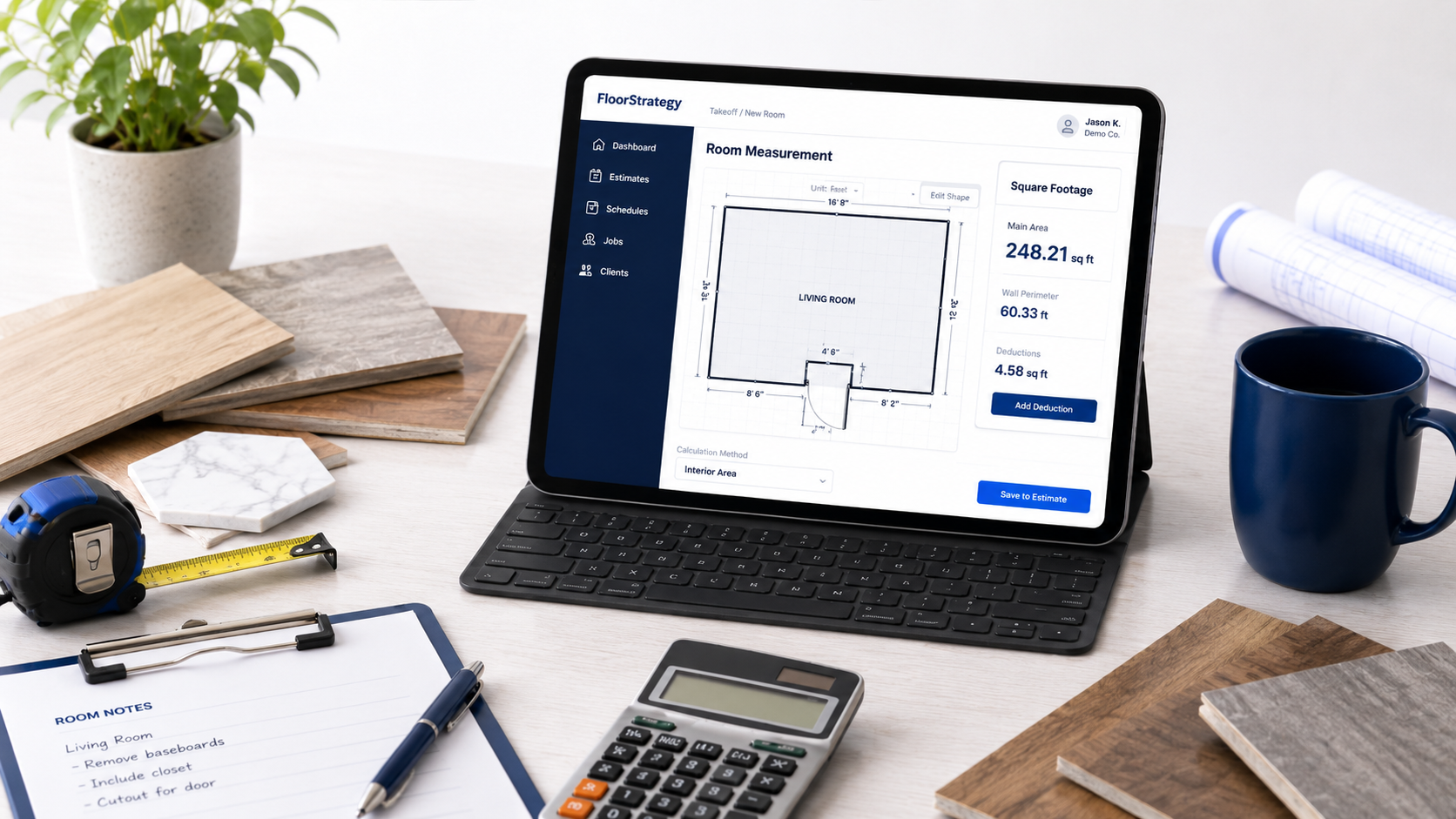
By Garrett Green, flooring production manager and founder of FloorStrategy
A 12-square-foot closet doesn't seem like much. But multiply that by six bedrooms in a house, and you've got 72 square feet of flooring and labor that can quietly vanish from an estimate if nobody walks into the closets.
That's the thing about square footage. The math itself — length times width — isn't hard. Where it goes wrong is everything around the math: the spaces that get skipped, the waste factor that doesn't match the material, the pattern that eats more product than the square footage alone suggests.
Key takeaways: Measure every space separately, including closets and transitions. Apply the right waste factor for the material — not a flat percentage across the board. Account for pattern direction and repeat on patterned materials. And always double-check total square footage against the floor plan, not just your own measurements.
Here's how to get square footage right, every time — whether you're measuring with a tape measure or reading it off a blueprint.
Measure Every Space Separately — Don't Estimate by Eye
The biggest mistake in square footage calculation isn't a math error — it's skipping spaces. Closets, hallways, nooks, and small transition areas are easy to overlook, especially when you're moving quickly through a walkthrough or scanning a floor plan.
Each space needs its own measurement: length times width, recorded individually. Even a small 3x4 closet is 12 square feet — and if you're flooring six bedrooms with closets in a house, that's 72 square feet of material and labor that can quietly disappear from your estimate if you're only measuring the "main" rooms.
The discipline here is simple: walk every room, measure every space, and write it down before you start adding things up. Resist the urge to "round up a little for the small stuff" — small stuff adds up to real square footage, and your material order needs to reflect it.
Account for Waste Factor — But Use the Right Percentage
Waste factor is the extra material you order beyond the exact square footage, to account for cuts, mistakes, pattern matching, and material defects. Every flooring material has a different waste factor, and using a flat percentage across all materials is one of the most common ways estimates go wrong.
Sheet vinyl and large-format tile typically need more waste factor because of how cuts and pattern matching work. Standard LVP and laminate usually need less. Hardwood with a specific plank pattern can need more again, especially in rooms with a lot of angles or transitions.
If you're applying a flat 10% waste factor to everything, you're probably over-ordering some materials and under-ordering others. Over-ordering isn't free — it ties up cash in inventory and can mean costly returns. Under-ordering means a mid-job material run, a delay, and an installer standing around waiting for product to arrive.
The right approach is to know the waste factor for each material type you commonly install, and apply it specifically — not as a one-size-fits-all buffer.
Pattern Direction and Repeat Change the Math
If you've worked with patterned materials — herringbone LVP, certain tile layouts, hardwood with directional grain — you know that square footage alone doesn't tell the whole story. The pattern repeat and the direction it runs relative to the room can significantly affect how much material you actually need.
A herringbone pattern run diagonally across a room often requires more material than the same square footage in a straight-lay pattern, because of how the cuts fall at the edges of the room. If your estimate doesn't account for this, you can end up short on material — and reordering a specific dye lot or pattern mid-job is a problem nobody wants.
This is one of those details that's easy to forget when you're focused on the big number, but it's exactly the kind of thing that turns into a frustrated installer and an emergency material order three days into a job.
Reading Square Footage from a Blueprint vs. Measuring On-Site
For new construction or larger commercial jobs, you're often working from a floor plan rather than measuring a finished space. This has advantages — you can do takeoffs before ever visiting the site — but it comes with its own pitfalls.
Floor plans often show square footage callouts for rooms, but those callouts don't always match the actual flooring area. A room's total square footage might include a closet that's getting different flooring, or might not account for a bump-out or alcove that needs its own calculation. Relying on a single square footage number printed on the plan, without verifying what it actually represents, is a common source of estimate errors on commercial jobs.
The safer approach is to treat the floor plan the way you'd treat an in-person walkthrough: identify every distinct space that needs flooring, measure or extract dimensions for each one individually, and build your total from those individual pieces — not from a single summary number.
This is also where blueprint reading gets time-consuming fast. A single-family home floor plan might have 10-12 rooms to measure. A commercial floor plan can have dozens of rooms, each with its own dimensions buried in the drawing. Doing this manually, room by room, is exactly the kind of repetitive work that eats hours on larger jobs — and where AI-assisted tools that extract room dimensions directly from a floor plan can save real time without sacrificing the room-by-room accuracy that matters.
Always Cross-Check Your Total
Once you've measured every space and added everything up, do one more thing before finalizing the number: sanity-check the total against the overall square footage of the area, if you have it.
If a floor plan lists a unit as 1,200 square feet total, and your room-by-room flooring takeoff comes out to 1,450 square feet of flooring area, something's off — either you're double-counting a space, or the 1,200 figure includes areas that aren't getting your flooring (like a tiled bathroom in an LVP job), or you've made a measurement error somewhere.
This cross-check takes two minutes and catches a surprising number of errors before they become a problem. It's the difference between finding a mistake at your desk versus finding it when the installer runs out of material on day two.
Why It's Worth Getting Right
Square footage accuracy isn't just about the price on the estimate — though that matters. It's the material order. Too little, and the job stalls waiting on product. Too much, and you've got inventory sitting around (or a return that may not even be possible, depending on the material and supplier).
When square footage is right, nobody notices. The job just runs. When it's wrong, everyone notices — usually at the worst possible moment.
A tape measure, a notepad, a spreadsheet filled in room by room from a floor plan — none of that is wrong, as long as the discipline holds. Every room measured individually. The right waste factor per material. A final cross-check before the number goes out the door.
Want estimates, scheduling, and client communication in one place? Start your free 30-day trial — no credit card required.
Reading floor plans room by room takes time. FloorStrategy's AI-assisted blueprint reader extracts room dimensions directly from floor plans — speeding up the takeoff without skipping the room-by-room accuracy that protects your material orders.