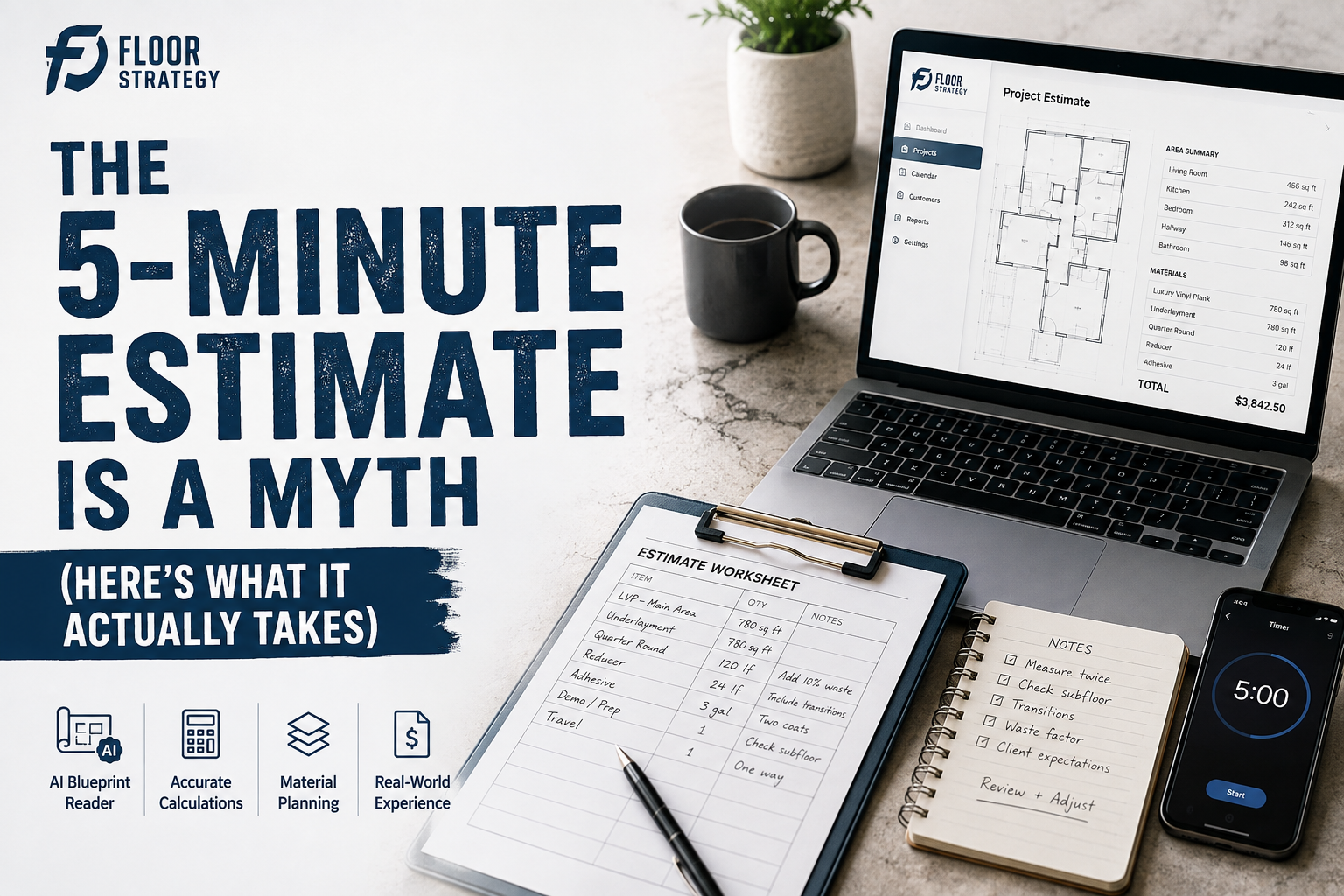
Every flooring salesperson has said some version of "I can get you a number in five minutes" at least once. And every flooring salesperson has also been burned by that number later, when the five-minute estimate turned into a job that lost money.
Here's the uncomfortable truth: a number you can trust doesn't come out of a five-minute conversation. It comes out of a process, and the process just happens to feel fast once you've done it a hundred times.
What actually has to happen before a number means anything
A real estimate has to account for square footage, material cost, waste factor, labor hours based on the specific install type, and any site conditions that change labor time — stairs, furniture moving, old flooring removal, subfloor prep. Skip any one of those and you don't have an estimate, you have a guess with a dollar sign on it.
The five-minute version usually skips waste factor (flat-rates it), skips site conditions (assumes a "normal" job), and skips labor variance (uses one blended labor rate for every install type). That's fine, right up until the job isn't normal — which, if you've been in this business more than a year, you already know is most jobs.
Why the myth persists anyway
Clients want a fast number, and salespeople want to close. So "how much would it cost to do my living room" gets answered on the spot, with a number that's really a placeholder wearing a estimate's clothes. Sometimes it works out fine. Sometimes that placeholder becomes the number on the invoice, and now you're trying to explain a change order to someone who thought they already had a final price.
The fix isn't slowing down the client conversation — it's speeding up your own math
The goal isn't to make clients wait longer. It's to get your internal process fast enough that a real number takes about as long as the fake one used to. That usually comes down to having your price lists, labor rates, and waste factors for common install types already dialed in ahead of time, so when you're standing in a living room, you're plugging real numbers into a real formula instead of doing mental math and rounding up "to be safe."
Rounding up "to be safe" is its own trap, by the way — it's not actually safe, it's just imprecise in a direction that sometimes helps you and sometimes doesn't. A close, defensible number beats a padded guess every time, because you can explain a close number when a client questions it. You can't explain a guess.
What to do instead of promising five minutes
Tell the client the truth: "I can walk the space with you now, and I'll have a real number to you by end of day." That's not slower in any way that matters to the client — most people don't actually need the number in the room, they need to know it's coming soon and it's going to hold up. A number that holds up is worth more to your close rate than a number that arrives instantly and gets revised twice before the job starts.