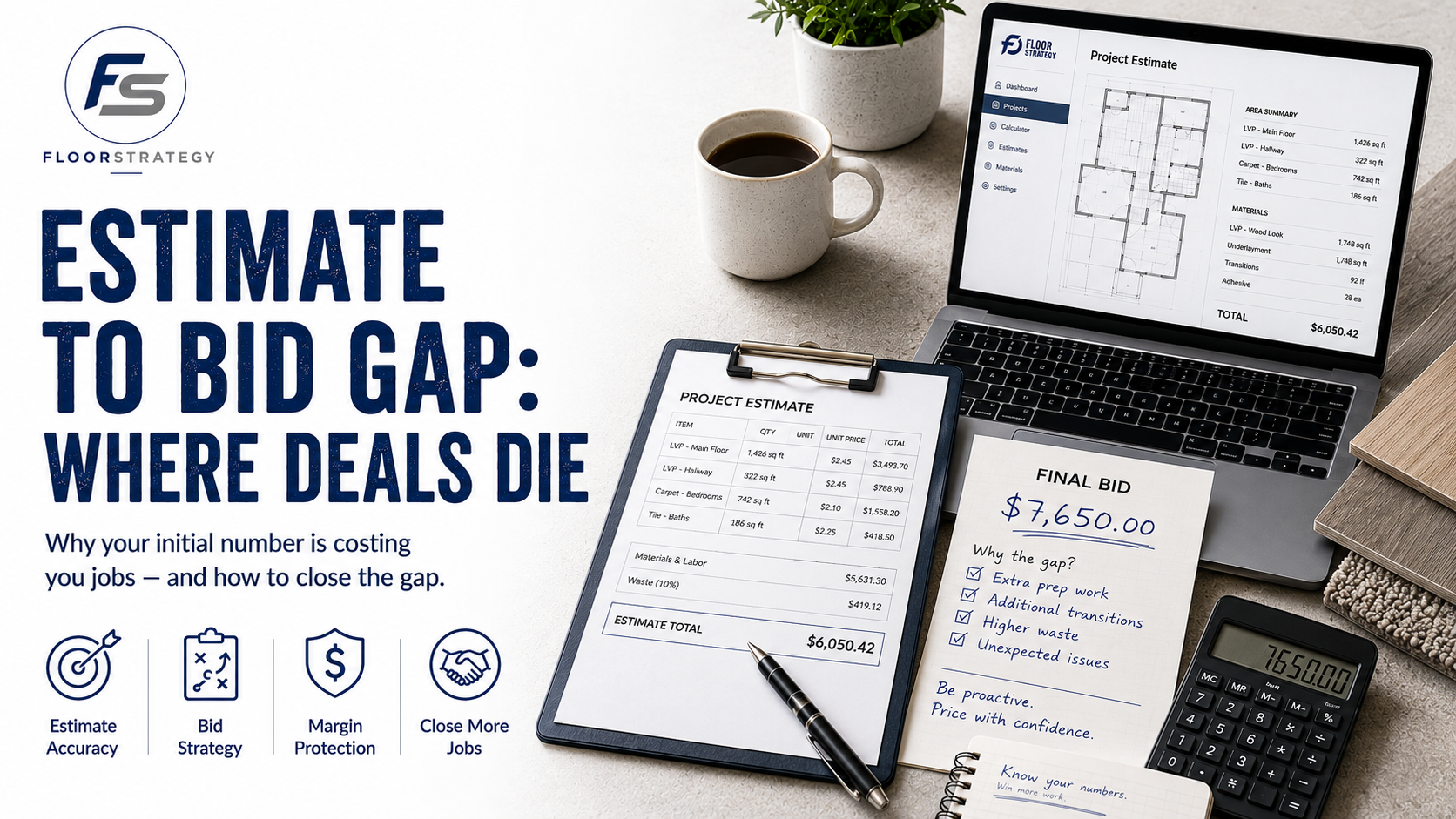
Every shop tracks how many bids they sold. Fewer shops track how many estimates never even made it to a bid in the first place — and that number is usually a lot bigger, and a lot more fixable, than most owners realize.
The gap isn't usually about price
It's tempting to assume a customer who never came back just found a cheaper competitor. Sometimes that's true. More often, the deal died somewhere between the walkthrough and the bid actually landing in the customer's inbox — and price was never the deciding factor, because the customer never got far enough to compare prices at all.
Where it actually breaks down
- Too much time between the walkthrough and the number. A customer who was excited on Tuesday has cooled off by the following Monday, especially if a competitor got them a number faster in the meantime.
- The bid doesn't match the conversation. If you talked about three rooms and a hallway during the walkthrough and the bid shows up looking like a generic template, the customer notices the mismatch even if they can't quite say why it feels off.
- No clear next step. A bid that just says "let us know if you have questions" puts all the momentum back on the customer. Momentum that gets handed back rarely comes forward again on its own.
- Nobody follows up. This is the biggest one. A bid sent and never mentioned again is, functionally, the same as a bid that was never sent.
What actually closes the gap
Speed matters, but it's not about being instant — it's about being predictable. A customer who's told "you'll have this by Thursday" and gets it Thursday trusts the number more than a customer who gets a same-day number that then changes twice over the next week.
The bid itself should mirror the actual conversation — real room names, the actual material discussed, not a generic template that could've been sent to anyone. It should also always end with a clear next step: a date to follow up, a way to accept online, something that keeps the ball moving instead of parking it in the customer's inbox indefinitely.
And the follow-up has to actually happen. Not as a guilt-trip "just checking in" message, but as a real touchpoint — answering a likely question before they ask it, mentioning installer availability, something that shows the bid is still active and someone's still paying attention to it.
The real lesson: a bid is not the finish line
Sending the bid feels like the end of the sales process, because it's the end of your active work on it. For the customer, it's often the actual start — the point where they're deciding, comparing, maybe talking it over with a spouse. Treating bid-sent as "done" is exactly how deals quietly die in a gap nobody's watching.